What Happens During a Foundation Inspection?
If you’ve noticed a new foundation crack, uneven floors, a sticking door, or a basement wall that does not look quite straight, scheduling a foundation inspection is usually the next step. But if you’ve never had one before, it might not be obvious what the contractor is actually going to do once they arrive.
A good foundation inspection is more than a quick look at one crack. The goal is to understand how the house is behaving as a whole, determine whether there is meaningful structural movement, and identify conditions that may be contributing to the problem.
That can involve looking inside and outside the home, documenting cracks, taking measurements, checking drainage, and inspecting the basement or crawl space. The findings should then lead to a clear explanation of whether repairs are recommended and why.
Step 1: Start With What the Homeowner Has Noticed
The inspection usually begins with a conversation. You may have called because a crack appeared above a doorway, a section of flooring feels lower than it used to, or water has started entering a basement after heavy rain.
Those observations help the inspector know where to start, but they shouldn’t limit the inspection to that one spot. A crack in a living-room wall, for example, may relate to movement at the foundation several feet away. A sagging floor may point toward crawl-space framing rather than the perimeter foundation.
If you have old photos, previous repair records, or notes showing when a crack appeared, those can be useful. Photos taken several months apart are especially helpful when trying to determine whether something is changing.
Step 2: Look at the Exterior of the Home
Foundation movement often leaves clues outside.
An inspector may look for stair-step cracks in brick or block, separation around windows and doors, gaps at exterior trim, cracks in exposed foundation walls, or areas where different sections of the home appear to have shifted relative to one another.
Drainage matters too. Gutters, downspouts, grading, nearby slopes, patios, and low areas beside the foundation can affect how much water reaches the soil around the house.
That does not mean poor drainage automatically caused every crack. It does help explain the conditions the foundation has been dealing with over time.
Step 3: Check the Basement or Crawl Space
Much of the useful evidence is often underneath the home.
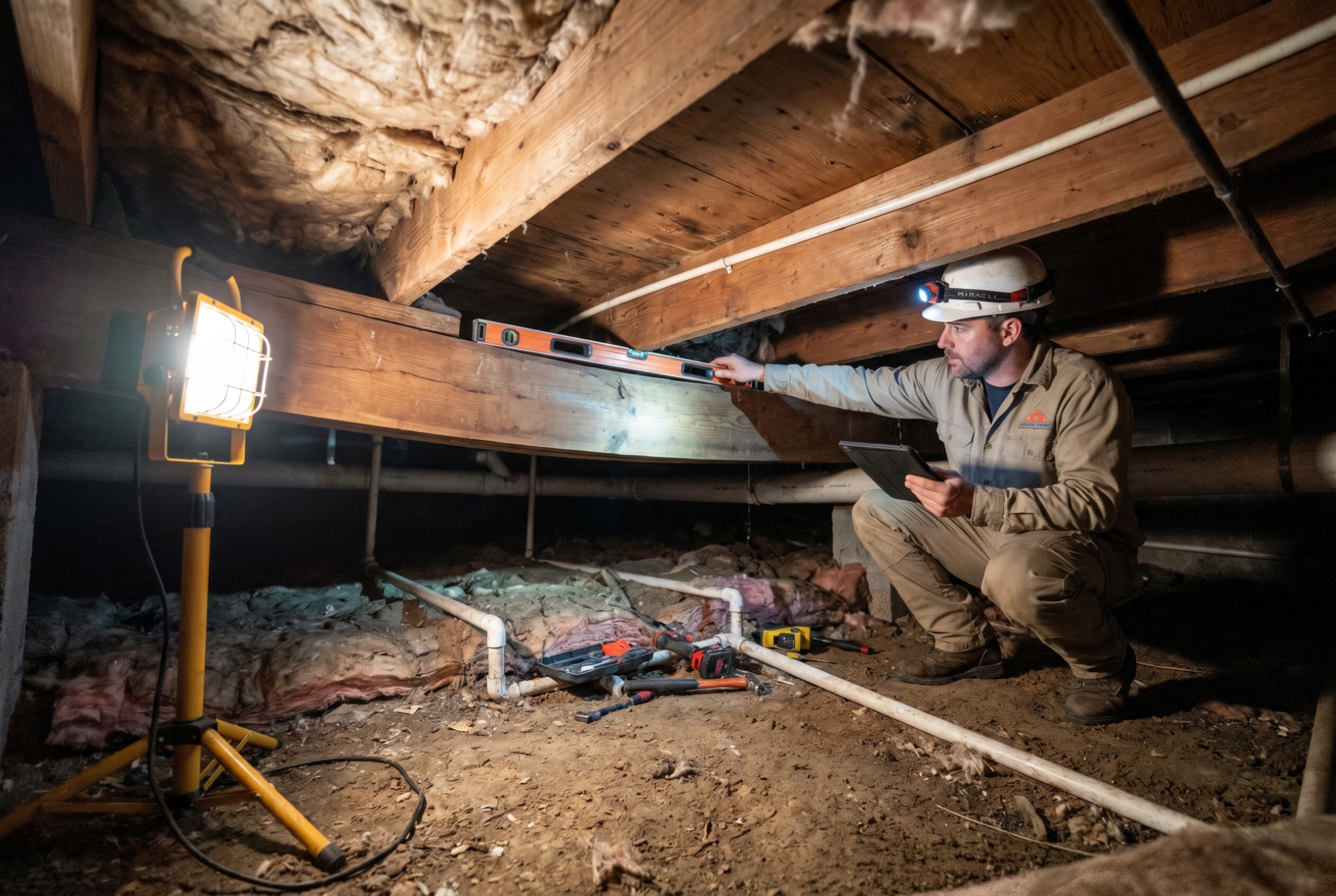
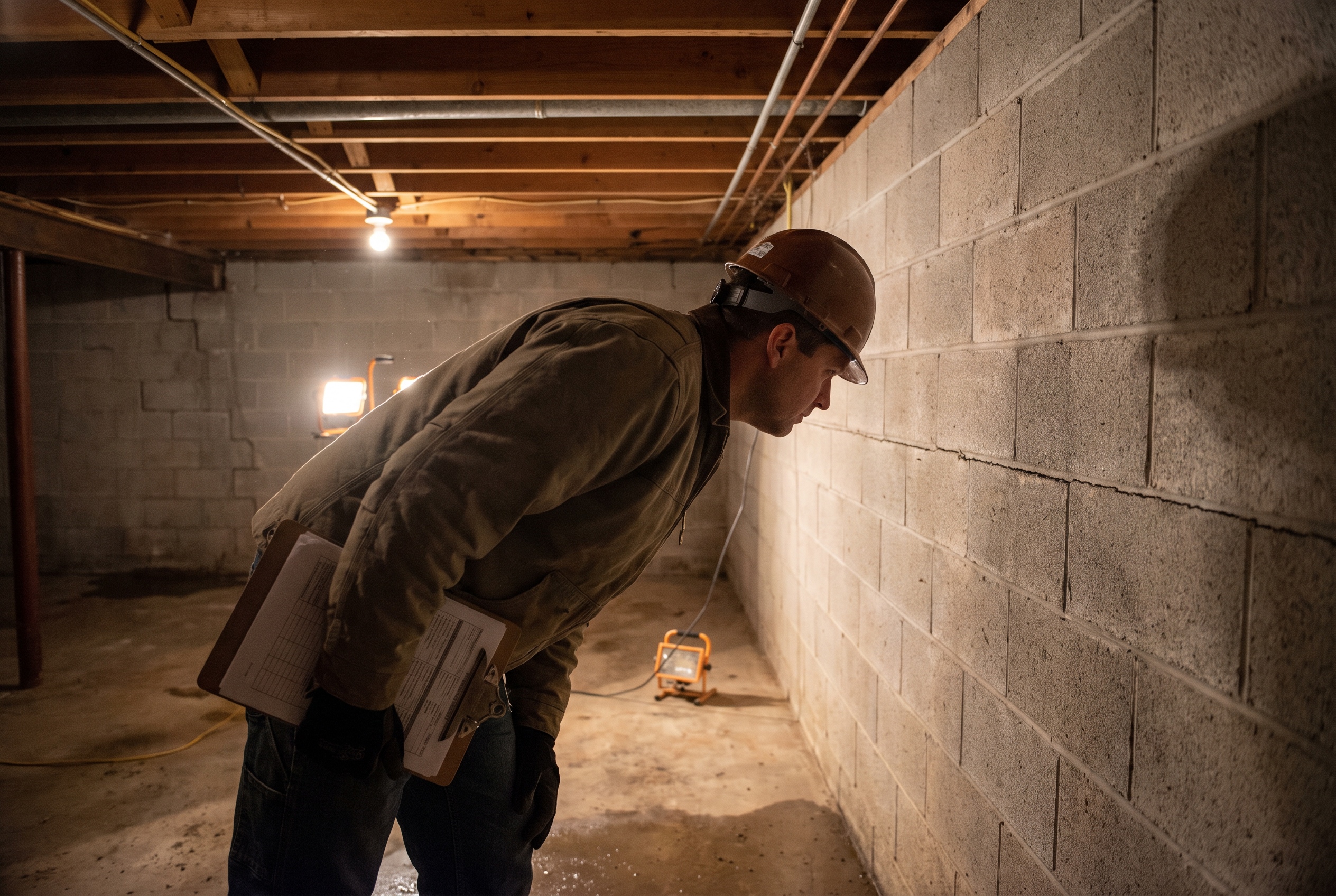
In a basement, the inspector may check foundation walls for horizontal cracks, stair-step cracking, inward bowing, water intrusion, or displacement between blocks. In a crawl space, attention may shift to beams, floor joists, support columns, moisture conditions, and signs that the framing has sagged or weakened.
Level Up also handles crawl space repair, so an inspection can distinguish between a perimeter-foundation problem and an issue involving the structure beneath the floors.
This distinction matters because similar symptoms upstairs can come from different places. An uneven floor could relate to settlement at the exterior foundation, but it could also come from a weakened beam, an inadequate support, or moisture-damaged framing in the crawl space.
Step 4: Measure the Movement
Visual clues tell part of the story. Measurements help put those clues into context.
Depending on the problem, an inspector may measure crack widths, wall deflection, floor elevation differences, or other signs of movement. The point is to establish exactly how much something has shifted rather than relying only on how dramatic it looks.
A long crack can look alarming while showing very little displacement. A smaller crack may be more important if it appears alongside measurable settlement or a wall that is moving out of plumb.
Level Up’s inspection process as includes photos and measurements so the recommendation is based on documented conditions rather than a visual guess.
Step 5: Look for a Pattern, Not Just One Symptom
Foundation problems tend to make more sense when several observations are considered together.
For example, stair-step cracking on one corner of the home, a nearby sticking window, and measurable floor movement in the same area may point toward settlement. A horizontal basement-wall crack combined with inward deflection may suggest lateral soil pressure.
By contrast, a single narrow drywall crack with no other movement may turn out to be cosmetic or something worth monitoring rather than repairing immediately.
Level Up has a guide to common signs of foundation problems, including stair-step cracks, uneven floors, sticking doors and windows, and bowing basement walls.
Step 6: Consider What May Be Causing the Problem
Finding movement is only part of the inspection. The next question is why it happened.
Foundation settlement can be influenced by soil conditions, erosion, poorly compacted fill, changes in moisture, or water repeatedly collecting near the home. Bowing basement walls may be related to pressure from wet or expansive soil outside the foundation.
Crawl-space problems can involve a different combination of causes, including moisture, deteriorated framing, inadequate supports, or movement beneath existing columns.
The repair should address the type of movement that is actually occurring. That is why Level Up offers several foundation repair solutions, including piers, carbon fiber reinforcement, and wall anchors rather than relying on one system for every house.
What Happens If the Foundation Does Need Repair?
If the inspection identifies a repairable structural problem, the contractor should explain what was found, what repair method is being recommended, and why that method fits the problem.
A settling section of foundation may call for helical or push piers. A mildly bowing basement wall may be a candidate for carbon fiber reinforcement, while more significant wall movement may require anchors or another stabilization method.
Crawl-space movement may instead involve support jacks, beam reinforcement, joist repair, or moisture-control work.
The estimate should make clear where the work will be performed and what is included. Level Up’s free inspections are followed by a written, line-item estimate so homeowners can see the proposed scope before deciding whether to proceed.
What If the Inspector Says You Do Not Need Foundation Repair?
That is a legitimate outcome of an inspection.
Homes move a little over time, and cracks can develop for reasons that do not require structural stabilization. Some conditions may simply need monitoring. Others may be related to drainage, waterproofing, or a non-foundation component of the house.
A useful inspection should narrow down the problem even when the answer is not a foundation-repair project.
If monitoring is appropriate, ask what changes would justify another inspection. Taking dated photographs and occasional measurements can make future comparisons much easier.
Is a Contractor Foundation Inspection the Same as an Engineer’s Inspection?
No. A foundation repair contractor evaluates the home with the goal of identifying foundation problems and determining whether the contractor’s repair systems are appropriate. A licensed professional engineer can provide an independent engineering evaluation when that level of analysis or documentation is needed.
There are situations where a homeowner may want an engineer involved, particularly when a problem is unusually complex, an independent structural opinion is required, or engineering documents are needed for another purpose.
For repair work, homeowners should also verify that the company they hire is properly licensed. The Virginia Department of Professional and Occupational Regulation recommends working with licensed contractors, checking license status, and getting written estimates. Its consumer guide to hiring a contractor provides additional information for Virginia homeowners.
How Much Does a Foundation Inspection Cost?
Inspection policies vary by company. Some contractors charge for consultations or certain types of evaluations, while others offer inspections as part of the estimating process.
Level Up Foundation Repair provides free, no-obligation inspections. These include a walk-through, photo documentation, and a written estimate without a trip or consultation fee.
Before scheduling with any company, it’s reasonable to ask whether the inspection has a fee and what you will receive afterward.
How Should You Prepare for a Foundation Inspection?
You usually don’t need to do much. Make sure the inspector can reach the areas where you have noticed problems and provide access to the basement or crawl space if one is present.
It can also help to gather:
- Photos showing when cracks or movement first appeared
- Records from previous foundation or waterproofing work
- Notes about when doors, windows, or floors started changing
- Information about where water collects after heavy rain
- Questions you want answered before discussing repairs
You do not need to diagnose the house yourself before the appointment. Showing the inspector what you have noticed and when you noticed it is usually more useful than trying to determine the cause in advance.
What Should You Know When the Inspection Is Over?
By the end of a foundation inspection, you should have a clearer understanding of what was found, whether the condition appears to need repair, and what the recommended next step would accomplish.
If repair is proposed, ask why that particular method was selected and whether there are reasonable alternatives. The explanation should connect the repair to the measurements and conditions observed during the inspection.
Level Up Foundation Repair provides free foundation inspections across Central and Southwest Virginia. If you have noticed cracking, uneven floors, sticking doors, bowing walls, or another possible sign of movement, schedule a free inspection with us to have the problem documented and evaluated.
FAQ
How long does a foundation inspection take?
The time required depends on the size and accessibility of the home and the problem being investigated. A straightforward crack evaluation may take less time than a home with several areas of movement, a crawl space, drainage problems, and multiple structural symptoms.
What does a foundation inspector look for?
An inspector may evaluate cracks, wall movement, floor elevation differences, exterior settlement signs, crawl-space framing, drainage, and other conditions that could help explain what is happening to the structure.
Do I need to move furniture before a foundation inspection?
Usually not, although the inspector needs reasonable access to the areas showing symptoms as well as the basement, crawl space, or exterior foundation. Moving a few stored items away from an important crack or access opening can make the inspection easier.
Will a foundation inspection automatically lead to a repair estimate?
Not necessarily. An inspection may determine that repairs are appropriate, that another type of work should be considered, or that the condition can simply be monitored. When Level Up recommends repair, we provide a written, line-item estimate explaining the proposed scope.