The Question We Hear More Than Almost Any Other
Homeowners call us with a lot of concerns, but one comes up constantly: “Is my foundation too far gone to repair? Do I need to replace the whole thing?” It’s an understandable worry. Foundation problems sound serious, and if you’ve been reading around online or getting quotes from other companies, you may have already heard some alarming language. We want to be straight with you about what foundation repair vs. replacement actually means, and why in most cases, the answer isn’t nearly as dramatic as it sounds.
Full foundation replacement is one of the most expensive projects a homeowner can undertake. We’re talking tens of thousands of dollars, significant excavation, temporary structural support for the entire house, and weeks of disruption. It’s occasionally the right call. But it’s genuinely rare. The vast majority of foundation problems we see across Central and Southwest Virginia, including cracked walls, settling corners, and bowing or leaning sections, are repairable without tearing anything out and starting over.
What Foundation Replacement Actually Means
When people talk about replacing a foundation, they typically mean one of two things: either removing and rebuilding a failed section of the foundation wall, or in more extreme cases, underpinning and reconstructing the entire foundation system. Both involve heavy excavation, lifting the structure, forming and pouring new concrete or block, and extensive backfill. The logistics alone make it a last resort.
There are situations that legitimately push a foundation toward replacement territory. A complete collapse of a block wall, severe deterioration from long-term water intrusion combined with freeze-thaw damage, or catastrophic settling that has compromised structural integrity beyond what repair methods can address are real scenarios. They just aren’t common. When we walk through a home and assess the damage honestly, we can usually tell you which category you’re in.
What Foundation Repair Can Actually Handle
Modern foundation repair methods are more capable than a lot of homeowners realize. Depending on what’s happening with your foundation, targeted repairs can stabilize settled footings, straighten or reinforce bowing walls, and stop the problem from getting worse; all without replacing anything.
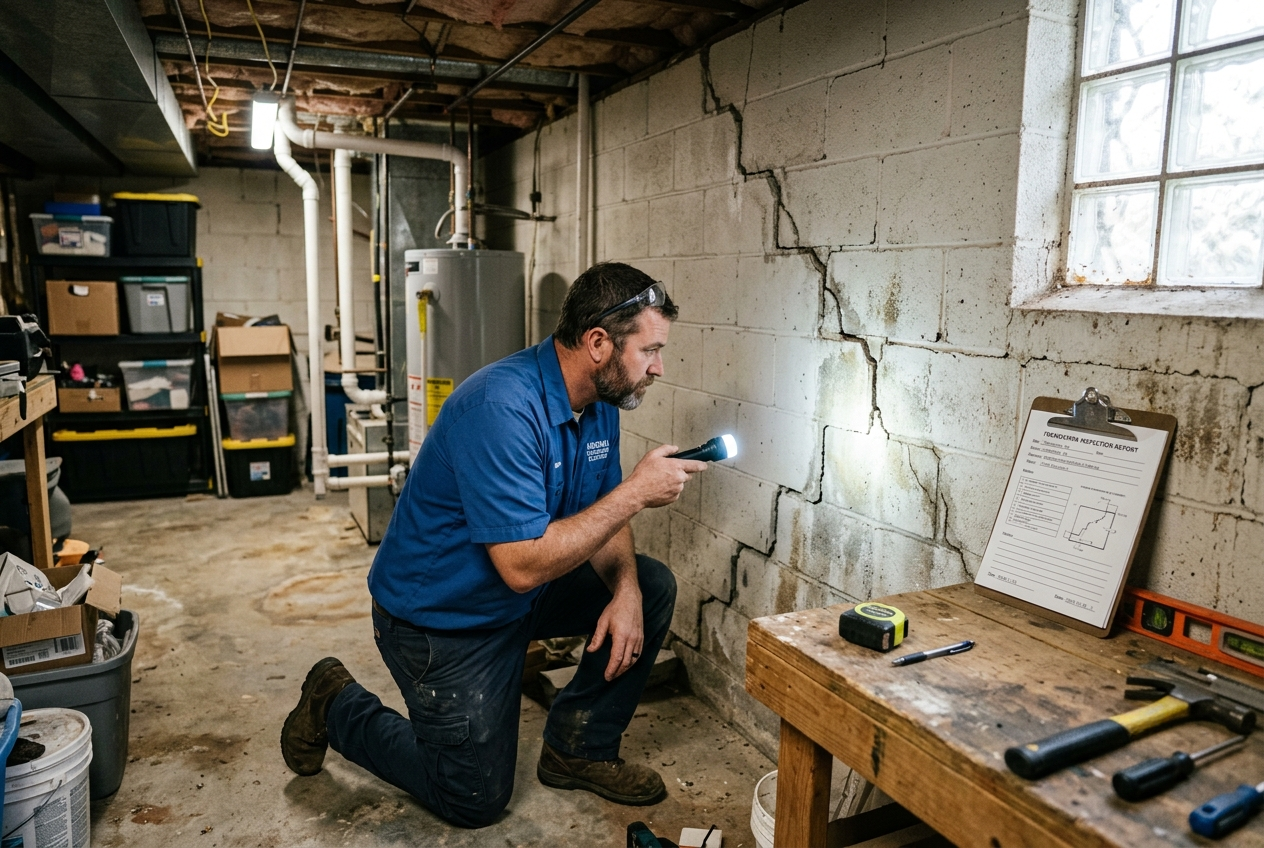
For foundations that are sinking or settling unevenly, helical piers or push piers can be driven down to load-bearing soil or bedrock and used to stabilize or even lift the affected section. For basement walls that are bowing inward due to soil pressure, something we see frequently in Virginia’s clay-heavy soils, carbon fiber straps can reinforce the wall and halt further movement. Horizontal cracks, stair-step cracks in block foundations, and vertical settlement cracks are not automatic signs that a wall needs to come down. They’re signs that something needs attention and proper diagnosis.
The clay soils common throughout the Appomattox area, Lynchburg, the Roanoke Valley, and much of Central Virginia expand and contract significantly with moisture changes across the seasons. That movement puts a lot of pressure on foundations over time. It’s why foundation problems are so common here, and it’s also why targeted stabilization and repair methods designed for exactly these conditions tend to work well.
Why Some Companies Lead With Replacement
We’ll be honest here: there’s a financial incentive for some contractors to recommend more work than what’s necessary. Foundation replacement and large-scale underpinning projects carry much bigger price tags than a targeted pier installation or a wall reinforcement. We’re not saying every company operates this way, but it’s worth knowing that the framing you get in an estimate can be influenced by what a company wants to sell you.
Our approach is different. When we do a free inspection, we’re looking at what’s actually happening and recommending what actually fixes it. If two helical piers and a carbon fiber strap can stabilize a corner that’s been slowly settling, that’s what we’re going to tell you. We’re not going to recommend full-perimeter underpinning because it sounds more thorough. Targeted repairs done right are just as effective, and they cost a fraction of the price.
If you’ve gotten a quote that feels outsized for what you’re seeing, it’s worth getting a second opinion. We offer free inspections and free estimates with no pressure to commit. Come see what we find.
Signs That Repair Is the Right Answer
Most of the foundation concerns we get called out for fall into the repairable category. Some indicators that targeted repair is likely sufficient: cracks that are stable or slow-moving rather than actively widening, bowing walls that haven’t yet reached critical displacement, corners or sections that have settled while the rest of the foundation remains sound, and water intrusion that can be addressed with a proper drainage system rather than structural intervention.
None of this means you should sit on the problem. Foundation issues that are manageable now can become significantly worse over time, especially with Virginia’s wet springs and the soil movement that comes with them. The sooner a problem gets properly assessed, the more options you typically have, and the lower the cost tends to be.
You can also review the common signs of foundation problems on our site to get a better sense of what you’re looking at before we come out.
Signs That Replacement Might Be Necessary
There are cases where replacement is genuinely the right call. A wall that has deteriorated beyond the point where it can bear load, catastrophic cracking across multiple sections, or a foundation that has shifted so severely that the structure above has been significantly compromised; these situations are real, even if uncommon. The honest answer from us in those cases is still the honest answer. We’re not going to talk you into a repair that won’t hold just to avoid the harder conversation.
What you should expect from any foundation contractor is a clear explanation of the damage, what’s driving it, what your repair options are, and what happens if you do nothing. If you’re not getting that, find someone who will give it to you.
Schedule a Free Inspection With Level Up
If you’re weighing foundation repair vs. replacement and trying to figure out what your home actually needs, the best first step is a no-pressure inspection by someone who’s going to tell you the truth. We serve homeowners throughout Central and Southwest Virginia, including Lynchburg, Forest, Bedford, Roanoke, Charlottesville, Appomattox, Danville, and the surrounding areas.
We’ll take a look, tell you exactly what we see, and give you a clear picture of your options. No scare tactics, no padding the scope. Contact us to schedule your free inspection.
Frequently Asked Questions
How do I know if my foundation needs repair or full replacement?
Most foundation problems, including cracking, settling, and bowing walls, can be addressed with targeted repair methods without replacing the foundation. Full replacement is typically reserved for foundations that have deteriorated structurally to a point where repair methods can no longer adequately stabilize them. A professional inspection is the only reliable way to know which situation you’re in.
How much does foundation repair cost compared to replacement?
The gap is significant. Targeted foundation repairs using piers, carbon fiber straps, or wall anchors can often run a few thousand to several thousand dollars depending on the scope. Full foundation replacement can run $30,000 to $100,000 or more depending on the size of the home and the extent of the work. This is part of why getting an honest assessment matters, and why we focus on fixing what actually needs fixing rather than recommending the largest possible scope.
Can a repaired foundation last as long as a replaced one?
Yes, when the repair is properly diagnosed and correctly installed. Helical piers and push piers are designed to provide long-term stabilization. Carbon fiber reinforcement for bowing walls carries manufacturer warranties. A repair that actually addresses the root cause of the problem, whether that’s settling soil, hydrostatic pressure, or clay expansion, can hold for the life of the home.
Does Level Up Foundation Repair offer warranties on their work?
Yes. Our repairs are warranty-backed, and we use the same quality materials as larger regional competitors. Being a locally owned company in Appomattox doesn’t mean cutting corners; it means we stand behind our work and we’re here if you ever have a follow-up concern. You can learn more about us and how we operate on our site.