What Causes Bowing Basement Walls?
A basement wall is built to support the home above while also holding back the soil outside. Most of the time, it does both jobs quietly for decades. When pressure from the surrounding soil becomes greater than the wall was designed to handle, though, the wall can begin to crack, lean, or bow inward.
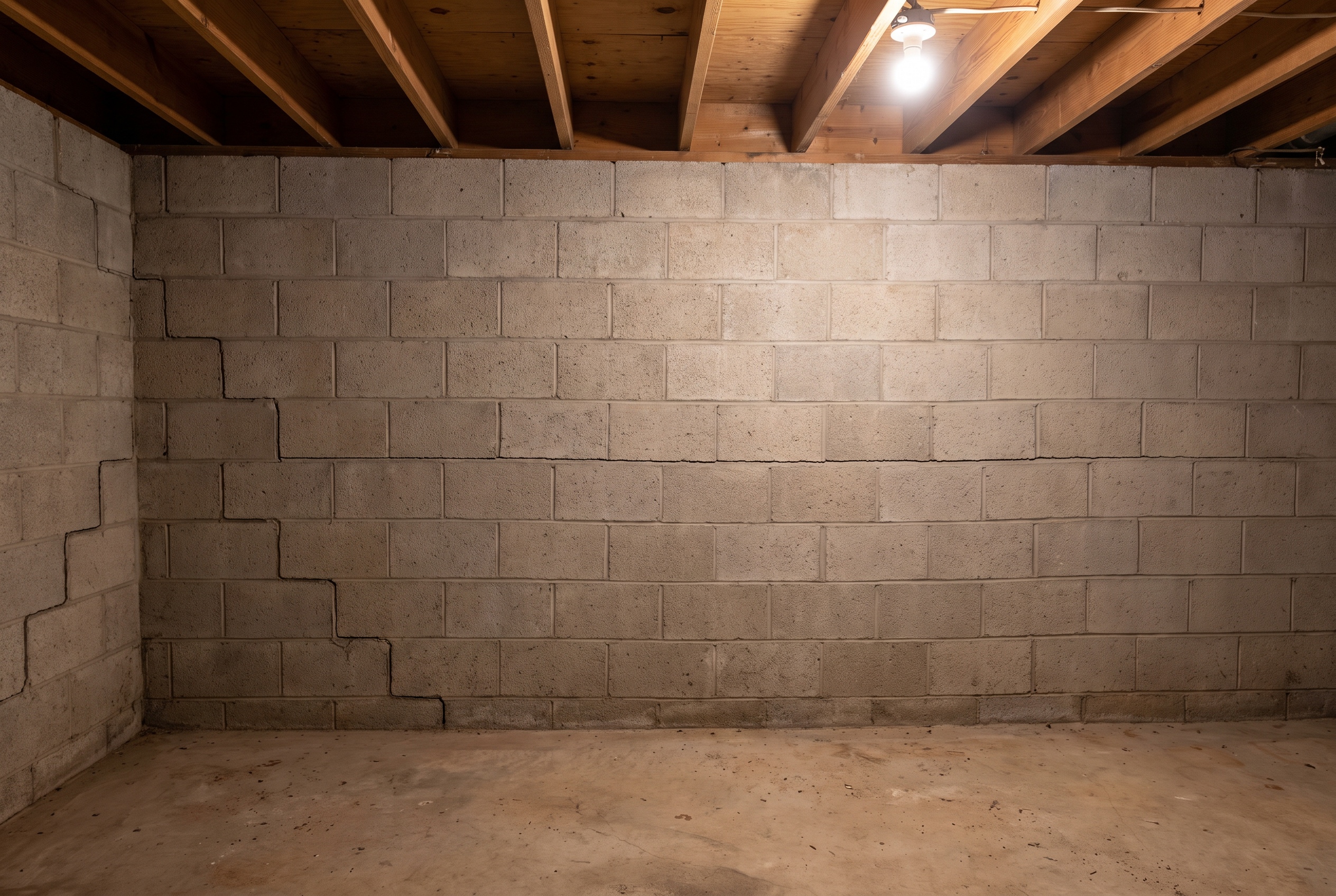
Bowing basement walls often develop gradually. A homeowner may first notice a horizontal crack across a block wall, a stair-step crack near a corner, or a wall that no longer looks perfectly straight when viewed from one end. In other homes, the first clue is water seepage through a crack after heavy rain.
These signs deserve an inspection, but they do not automatically mean the wall is about to fail or needs to be rebuilt. The amount of movement, wall construction, drainage conditions, soil pressure, and crack pattern all help determine what kind of repair makes sense.
Why Soil Pressure Can Push a Basement Wall Inward
Much of a basement wall sits below grade with several feet of soil pressing against the exterior. Dry, well-drained soil creates one set of loads. Saturated soil can create much more pressure.
After heavy rain, water fills the spaces between soil particles around the foundation. Poor grading, overflowing gutters, short downspouts, and ineffective foundation drainage can keep that soil wet for longer than it should be. Water itself can exert pressure against the wall, while saturated soil becomes heavier and can increase the lateral force the foundation has to resist.
This is one reason a wall may seem unchanged through a dry stretch and then show new cracking after a particularly wet season. The wall has not suddenly become weaker overnight. Conditions outside it may have changed enough to expose a problem that was already developing.
Expansive Clay Can Add to the Pressure
Soil moisture is especially important where expansive clay is present. Clay-rich soils can change volume as their moisture content changes, swelling when they absorb water and shrinking as they dry.
The Virginia Department of Energy explains that expansive soils can create significant pressure as they swell and that repeated wetting and drying puts stress on structures. The agency also notes that prolonged drought followed by soil-saturating rainfall can worsen expansive-soil hazards. Homeowners can read more about expansive soils in Virginia.
That wet-dry cycle is familiar across many parts of Central Virginia. A hot, dry period may be followed by several intense rainstorms, changing soil moisture quickly around the house. Conditions vary considerably from property to property, so the presence of clay alone does not mean a basement wall will bow. Drainage, construction, slope, backfill, and local geology all play a role.
Poor Drainage Can Make Wall Pressure Worse
Water management deserves a close look whenever a basement wall is moving. Even a structurally sound wall benefits from keeping unnecessary water away from the foundation.
Gutters should carry roof runoff into working downspouts, and those downspouts should discharge far enough from the house that water does not immediately soak back into the foundation area. The ground should generally encourage runoff away from the home rather than forming low spots beside the wall.
Foundation drainage matters below grade as well. Perimeter drains are intended to collect water near the footing and move it away before it builds up around the basement. If a drainage system is missing, damaged, or no longer functioning well, wet soil may remain against the wall after storms.
Correcting drainage will not straighten a wall that has already moved, but it may be an important part of reducing the conditions that contributed to the problem.
What Does a Bowing Basement Wall Look Like?
A bowed wall is not always dramatic. Early movement may be easier to spot through cracking than through the shape of the wall itself.
Common warning signs include:
- A horizontal crack running across a block or poured concrete wall
- Stair-step cracks following mortar joints
- A wall that appears to bulge inward near the middle
- Separation or movement near the top of the foundation wall
- Cracks that continue to widen or return after patching
- Water seepage through foundation wall cracks
- Visible displacement between courses of concrete block
Horizontal cracking deserves particular attention because it can indicate lateral pressure against the wall. Still, the crack needs context. Its location, width, length, and any measurable wall movement are more useful than simply declaring every horizontal line an emergency.
How Are Bowing Basement Walls Repaired?
The repair method depends heavily on how far the wall has moved and what is causing the movement. A wall showing early deflection may have different options than one that has moved several inches or developed significant displacement.
Two common stabilization methods are carbon fiber reinforcement and wall anchors.
Carbon Fiber Straps
Carbon fiber straps are bonded vertically to the inside face of the foundation wall using structural epoxy. Once installed, the high-strength reinforcement helps resist further inward movement while remaining nearly flush with the wall.
Carbon fiber can be a good fit when movement is identified early enough and the wall does not need substantial correction. It requires little usable basement space and generally avoids exterior excavation. The finished straps may also be painted or covered when the basement is finished later.
Level Up installs carbon fiber foundation reinforcement for appropriate cracked and bowing foundation walls. The goal of the system is stabilization. Existing bowing does not necessarily disappear simply because carbon fiber has been installed.
Wall Anchors
Wall anchors may be considered when a wall has moved farther inward or when the repair needs to provide greater corrective force. A typical system connects a steel plate on the interior basement wall to an anchor installed in stable soil outside the foundation.
The connecting rod places the wall and exterior anchor into tension, providing support against continued inward movement. Depending on the wall, soil conditions, access, and repair system, anchors may also allow gradual improvement in the wall’s position over time.
Wall anchors require adequate exterior space for the earth anchors, so landscaping, property lines, patios, driveways, utilities, and nearby structures can affect whether they are practical.
Does Waterproofing Fix a Bowing Basement Wall?
Waterproofing can address an important contributor to foundation-wall problems, but drainage work does not replace structural stabilization when a wall has already bowed.
If water regularly collects against the foundation, improving exterior drainage or installing a basement drainage system may reduce future moisture pressure. Cracks that leak may also need to be addressed as part of the waterproofing plan.
The structural movement still needs its own evaluation. A wall may need carbon fiber, anchors, or another engineered repair while drainage improvements deal with the water conditions outside it.
Level Up’s foundation repair services are intended to address the structural side of these problems, while waterproofing and drainage can be incorporated when moisture is part of the cause.
Can a Bowing Basement Wall Be Straightened?
Sometimes a wall can be partially corrected, but complete straightening is not always necessary or advisable. The first priority is usually to stop continued movement.
How much correction is possible depends on the wall material, amount of deflection, soil outside the wall, age of the movement, and repair system being used. Trying to force an older wall back into a perfectly straight position can introduce additional stress or damage.
Carbon fiber reinforcement generally focuses on stabilizing the wall in its current position. Anchor systems may offer more potential for gradual correction in suitable situations. An inspection should establish a realistic goal before work begins so the homeowner knows whether the plan is stabilization, improvement, or both.
When Should a Bowing Wall Be Inspected?
If you can visibly see the wall leaning or bulging inward, schedule an inspection. The same applies to a new horizontal crack, a crack that keeps widening, displaced concrete blocks, or several symptoms appearing in the same section of the foundation.
It is also worth having the wall checked if new movement appears after a season of heavy rain or dramatic wet-dry swings. Photos can be helpful for tracking changes, particularly if you include a ruler or another reference for scale.
A professional inspection can measure the wall, look at the crack pattern, evaluate drainage conditions, and determine whether movement appears active. From there, the repair can be matched to the actual condition of the foundation rather than assuming every bowed wall needs the largest system available.
Get a Clear Recommendation for Your Basement Wall
Bowing basement walls are worth addressing before movement has more time to progress, but the repair should fit the wall. Some homes are good candidates for low-profile carbon fiber reinforcement. Others need anchors or a more involved structural solution. Drainage may need attention at the same time.
Level Up Foundation Repair provides free inspections across Central and Southwest Virginia from its headquarters in Appomattox. If you have a horizontal crack, a leaning wall, or another sign of foundation movement, schedule a free inspection to find out what is causing it and which repair makes sense for your home.
FAQ
Is a horizontal crack in a basement wall always serious?
A horizontal crack can be a sign that outside soil pressure is pushing against the wall, so it deserves attention. The severity depends on the crack, wall movement, construction, and surrounding conditions. A small stable crack and a visibly displaced wall are very different situations.
Can heavy rain cause basement walls to bow?
Repeated saturation around the foundation can increase water and soil pressure against basement walls. Heavy rain may therefore contribute to movement, particularly where drainage is poor or expansive soil is present. Bowing usually develops from conditions acting over time rather than from a single ordinary rainstorm.
Can carbon fiber fix a bowing basement wall?
Carbon fiber can stabilize many foundation walls when the amount and type of movement are appropriate for the system. It is generally intended to resist further movement rather than force a significantly bowed wall back into a perfectly straight position.
When are wall anchors used instead of carbon fiber?
Wall anchors may be considered when the wall has more significant inward movement or when the repair plan calls for corrective force as well as stabilization. Soil conditions, exterior access, wall construction, and the amount of deflection all affect which method is appropriate.