Concrete Leveling vs. Replacement: Why the Right Choice Depends on the Slab
If your sidewalk, driveway, patio, garage floor, or concrete steps have started to sink, you may be comparing concrete leveling vs replacement. The question is practical: can the slab be lifted back into place, or does it need to be torn out and poured again?
The answer depends on the condition of the concrete and why it sank in the first place.
Concrete leveling can often correct sunken or uneven slabs without demolition. Replacement may be the better choice when the concrete is badly cracked, crumbling, heavily deteriorated, or no longer structurally sound. A slab that has simply settled is very different from one that has broken apart.
For homeowners in Central and Southwest Virginia, soil movement, heavy rain, poor drainage, erosion, and repeated freeze-thaw cycles can all affect exterior concrete. Before choosing a repair, it helps to understand what each option actually solves.
What Concrete Leveling Does
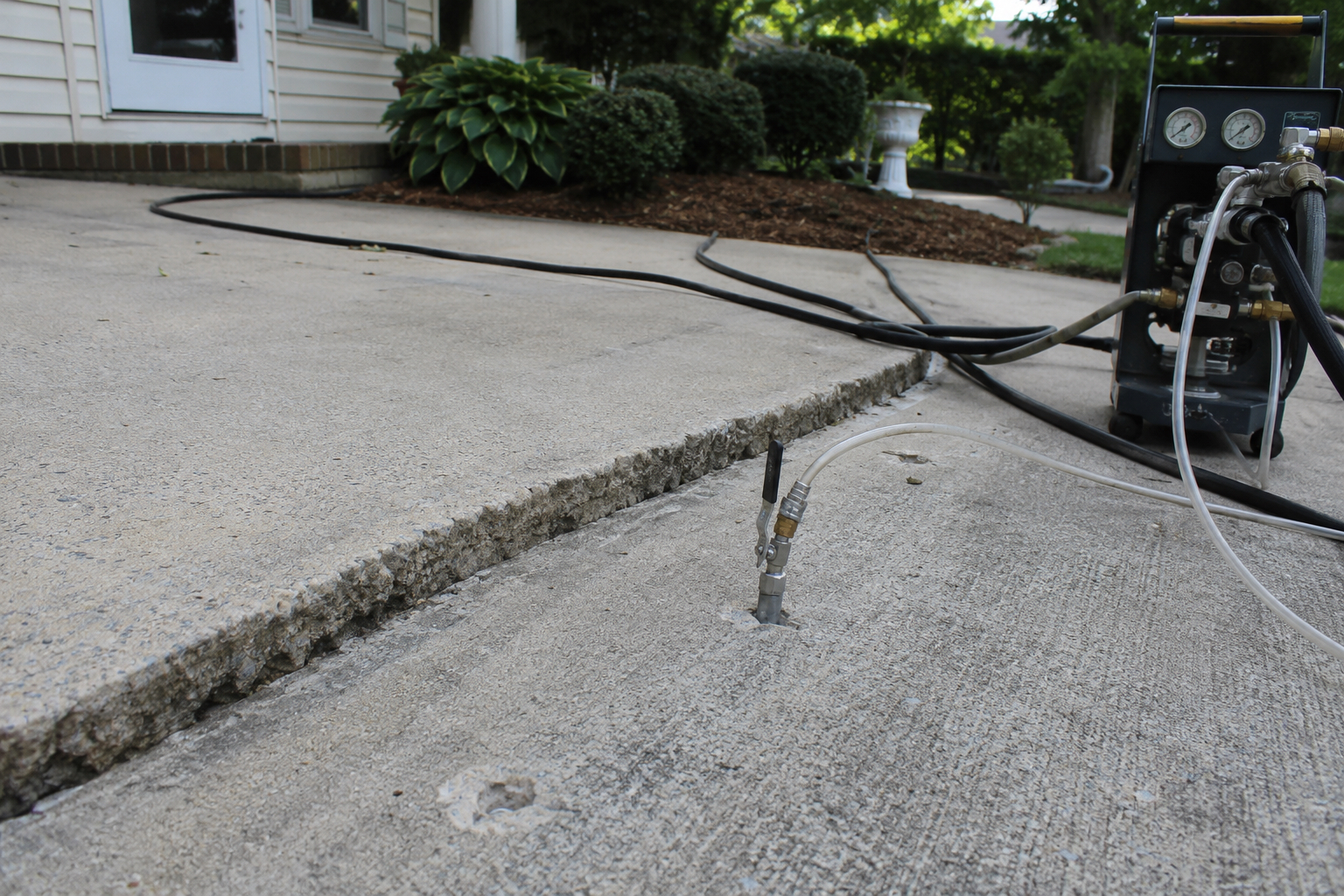
Concrete leveling is a repair method used to lift settled concrete back toward its original position. Instead of removing the entire slab, small holes are drilled into the concrete. A lifting material is injected beneath the slab to fill voids, support the concrete, and raise it as evenly as possible.
Level Up Foundation Repair uses concrete leveling services for sunken driveways, uneven sidewalks, settled patios, garage floors, and similar slab problems.
Polyurethane foam leveling is commonly used because it is lightweight, expands beneath the slab, and can cure quickly. That makes it a practical option for many residential concrete repairs where the slab itself is still in decent condition.
Concrete leveling is often less disruptive than replacement. There is no need to tear out the full slab, haul away broken concrete, build forms, pour new concrete, and wait for it to cure before use. In many cases, homeowners can use the area much sooner than they could with a full replacement.
What Concrete Replacement Does
Concrete replacement removes the existing slab and starts over. The damaged concrete is broken up, hauled away, and replaced with a new pour. Depending on the project, the base may also be rebuilt, compacted, graded, or reinforced before the new concrete is placed.
Replacement may be necessary when the slab is too damaged to lift reliably. If the surface is crumbling, if cracks run through the slab in multiple directions, or if pieces have separated and shifted independently, lifting may not produce a good long-term result.
Replacement also gives the contractor a chance to rebuild the base from scratch. That can be useful when the original concrete was poured over poor fill, shallow base material, or soil that has washed out repeatedly.
The tradeoff is cost, time, and disruption. Replacement usually involves more labor, more mess, more material, and more downtime than leveling.
When Concrete Leveling Makes Sense
Concrete leveling often makes sense when the slab has settled but is still mostly intact. A driveway section that has dropped near the garage, a sidewalk panel that has created a trip hazard, or a patio slab that slopes toward the house may be good candidates if the concrete is not severely broken.
Leveling may be a good fit when:
- The slab is sunken but not badly cracked
- The concrete surface is still in usable condition
- One or more sections have settled unevenly
- There are voids under the slab from erosion or washout
- The goal is to reduce a trip hazard or improve drainage
- The homeowner wants a less disruptive repair than replacement
Sidewalks and walkways are a common example. A small difference in height between slabs can be easy to trip over, especially near entrances, steps, and paths used by guests or customers. The U.S. Access Board’s guide to accessible routes explains that limited changes in level may be allowed under certain conditions, but larger changes need to be addressed differently for accessible routes.
Residential properties are not always being evaluated under the same rules as public accessible routes, but the safety idea still matters. Uneven concrete creates hazards. If someone catches a toe on a raised sidewalk edge, the repair becomes more than a cosmetic issue.
When Replacement Makes More Sense
Replacement may be the better option when the slab is too far gone. Concrete leveling can lift concrete, but it cannot turn badly deteriorated concrete into new concrete.
Replacement may make more sense when:
- The slab has deep, widespread cracking
- The concrete is crumbling or flaking apart
- Large pieces have separated from each other
- The surface is severely spalled or deteriorated
- The slab was poured too thin or has major structural defects
- The base underneath needs to be fully rebuilt
- The homeowner wants a new finish, layout, or shape
There are also times when replacement is part of a larger project. If a homeowner is redesigning a patio, widening a driveway, correcting major grade problems, or changing the way water moves around the home, starting over may be the cleaner choice.
That said, many sunken slabs do not need to be replaced. A repair should match the condition of the concrete, not default to the most expensive option.
Why Concrete Sinks in the First Place
Concrete usually sinks because the support underneath it changes. The slab itself may look like the problem, but the trouble often starts in the soil below.
In Central and Southwest Virginia, heavy rain can wash soil out from beneath sidewalks, driveways, patios, and steps. Downspouts that discharge beside concrete can erode the base over time. Poor grading can keep water moving toward the slab instead of away from it. Clay-heavy soil can expand and shrink as moisture levels change, which may create uneven support.
Once a void forms beneath the slab, the concrete has less support. Weight from vehicles, foot traffic, furniture, or the slab itself can cause it to drop into that weak area.
This is why the cause matters. If a driveway slab is lifted but the downspout still dumps water beside it, the same area may continue to be vulnerable. A good repair plan should look at drainage, soil washout, and water movement around the concrete.
Concrete Leveling vs Replacement for Driveways
Driveways often settle near the garage, along edges, or where water drains poorly. If the slab is still solid, concrete leveling may restore a smoother transition and reduce water pooling.
Replacement may be needed if the driveway has widespread cracking, broken corners, severe surface deterioration, or multiple sections that have shifted in different directions. Vehicle weight also matters. A slab that is already thin, weak, or poorly supported may not be worth lifting if it will continue to break down under use.
For many homeowners, the decision comes down to the concrete’s condition. Solid but sunken concrete is often a leveling candidate. Broken and deteriorated concrete usually points toward replacement.
Concrete Leveling vs Replacement for Sidewalks and Patios
Sidewalks and patios are often strong candidates for leveling because the slabs are smaller and the problem is frequently caused by voids, washout, or uneven support.
A sidewalk panel that has dropped an inch near one edge may be lifted to reduce the trip hazard. A patio that has settled toward the house may be improved if the slab is intact and the base can be supported. In both cases, drainage should be part of the conversation.
Replacement may be better if the patio has large cracks, the surface is badly worn, or the homeowner wants to change the shape, size, or finish. If the concrete is more patchwork than patio, lifting it may only buy time.
Concrete Leveling and Water Around the Home
Sunken concrete can create water problems. A settled patio, walkway, or driveway section may direct water toward the foundation. That water can contribute to basement seepage, crawl space moisture, soil erosion, and foundation stress.
If concrete has settled toward the home, the repair should not only focus on appearance. It should also consider drainage.
In some situations, Level Up may recommend concrete leveling along with other water-management improvements. If the home already has signs of basement moisture or foundation movement, the inspection may also include basement waterproofing or foundation repair concerns.
Concrete does not exist in a separate little kingdom. It affects how water moves around the house, and water is one of the main forces that causes problems below and around a home.
Which Option Costs Less?
Concrete leveling is often less expensive than full replacement because it usually requires less demolition, less labor, less material, and less downtime. That does not mean it is always the right repair.
The lowest-cost option is only useful if it actually solves the problem. Lifting a slab that is cracked beyond repair may not be money well spent. Replacing a solid slab that only needs support beneath it may also be unnecessary.
A practical estimate should explain what condition the concrete is in, what caused the settlement, whether leveling is realistic, and when replacement would be the better long-term choice.
How to Choose the Right Repair
Start by looking at three things: the condition of the slab, the amount of settlement, and the reason it moved.
If the concrete is mostly intact and the problem is uneven support underneath, leveling may make sense. If the slab is broken, crumbling, thin, or severely deteriorated, replacement may be more realistic. If water caused the settlement, drainage should be addressed so the repair has a better chance of lasting.
Level Up Foundation Repair focuses on targeted recommendations. Some sunken slabs can be lifted. Some should be replaced. Some should be evaluated alongside drainage, crawl space, basement, or foundation concerns.
If you are comparing concrete leveling vs replacement for your home, contact Level Up Foundation Repair for a free inspection and estimate across Central and Southwest Virginia.
FAQ
Is concrete leveling better than replacement?
Concrete leveling may be better when the slab is still in good condition but has settled because of voids, erosion, or weak support underneath. Replacement is usually better when the concrete is badly cracked, crumbling, or structurally failed.
How long does concrete leveling last?
Concrete leveling can be a long-term repair when the slab is a good candidate and the underlying cause is addressed. Drainage, soil conditions, slab condition, and installation quality all affect how well the repair holds up.
Can cracked concrete be leveled?
Sometimes. Minor cracks do not automatically rule out concrete leveling. Deep, widespread, or separated cracks may make replacement a better option. The slab needs to be inspected before making that call.
Does concrete leveling fix drainage problems?
Concrete leveling can improve drainage if it restores the slab to a better slope, but it does not fix every water issue by itself. Downspouts, grading, soil washout, and water flow around the home may also need attention.