
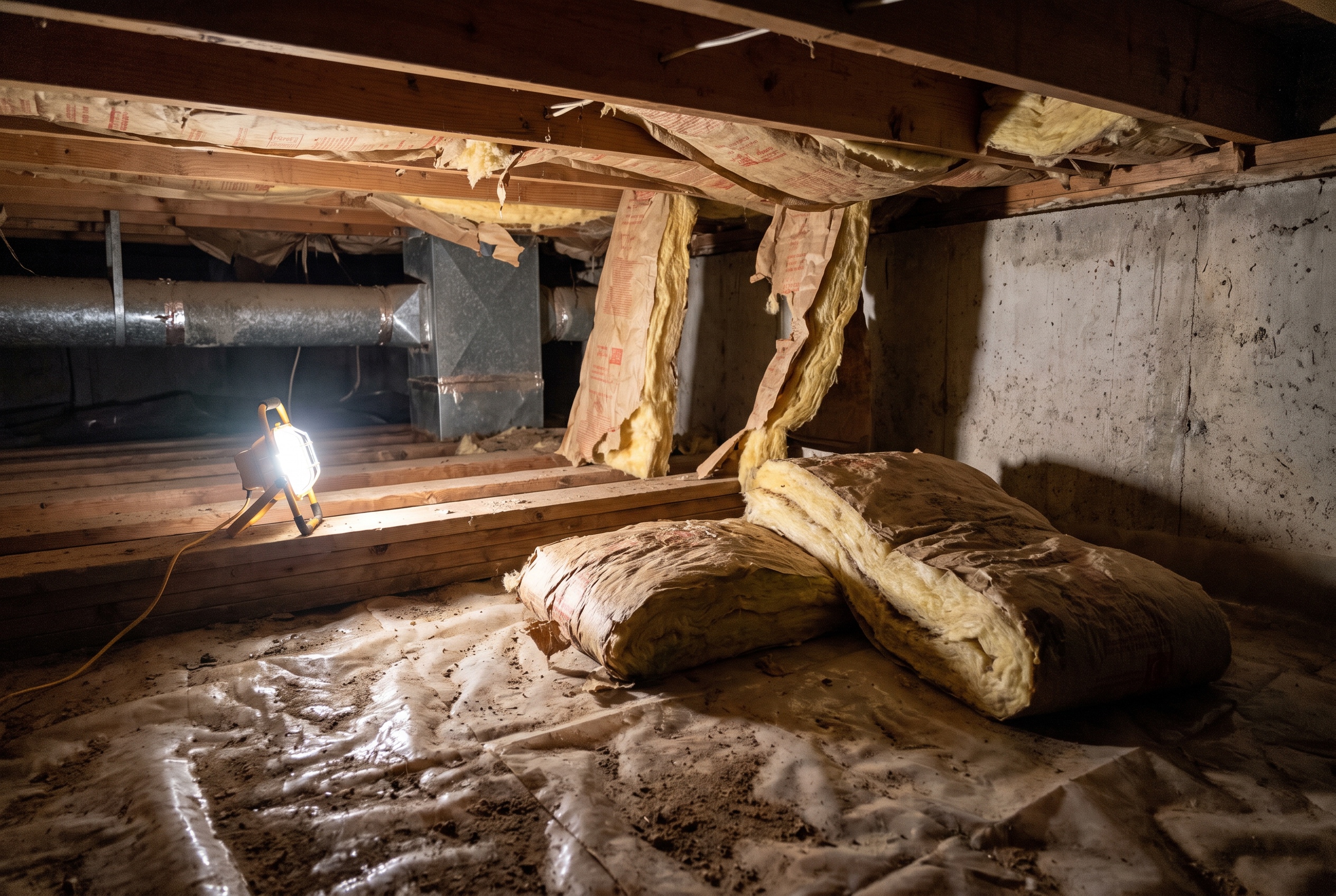
If you look into your crawl space and see fiberglass insulation hanging from the floor joists, lying on the ground, or drooping in large sections, there is usually a reason it stopped staying in place.
Sometimes the explanation is fairly simple. The insulation may have been poorly supported when it was installed, or gravity may have slowly pulled old batts loose. In other homes, falling insulation is one of the more visible signs of a moisture problem. Fiberglass can absorb moisture, become heavier, sag, and eventually drop out of the joist bays.
Virginia crawl spaces are especially vulnerable because humid summers, open foundation vents, ground moisture, and stormwater can all raise moisture levels below the home. Before pushing the insulation back into place or replacing it, it helps to find out why it fell in the first place.
Moisture Is a Common Cause of Sagging Crawl Space Insulation
Fiberglass insulation is light when it is dry. Once it is exposed to damp conditions for long periods, its performance and ability to stay securely in place can suffer.
Moisture can reach crawl-space insulation in several ways. Humid outdoor air can enter through foundation vents during the summer. Water vapor can rise from exposed soil. Plumbing leaks, poor grading, short downspouts, or drainage problems may introduce additional moisture. Cold ductwork and other cool surfaces can also create condensation when the surrounding air is humid enough.
ENERGY STAR identifies moisture control as one of the basic requirements for effective crawl-space insulation. Its crawl-space insulation guidance recommends managing rainwater and groundwater around the foundation before relying on insulation alone.
If several insulation batts are damp, stained, or noticeably heavier than they should be, simply securing them again may leave the real problem untouched.
Open Crawl Space Vents Can Contribute to the Problem
Older homes commonly have fiberglass batts installed between the floor joists with foundation vents left open to the outdoors. The idea was that ventilation would help the crawl space dry.
During a humid Virginia summer, the incoming air may add moisture instead. DOE Building America guidance notes that fiberglass batts installed between floor joists in vented crawl spaces can be vulnerable to moisture accumulation and condensation in humid climates.
That does not mean the vents should simply be blocked without considering the rest of the crawl space. A sealed crawl space needs a plan for ground moisture, drainage, humidity, and air movement. Closing the vents while leaving wet soil or standing water underneath the home can create another set of problems.
For homeowners dealing with persistent humidity, Level Up’s crawl space encapsulation systems are designed to control moisture by addressing the ground, vents, air leakage, and humidity together.
Poor Installation Can Make Insulation Fall Early
Not every sagging batt points to a wet crawl space. Sometimes the insulation was never secured very well.
Fiberglass installed between floor joists needs enough support to remain in contact with the surface it is intended to insulate. If the batts were cut too narrow, loosely fitted, or held up with inadequate supports, they may gradually work loose. Previous contractors may also have moved insulation aside to reach plumbing, wiring, or ductwork and never secured it properly afterward.
You may see this pattern when only a few isolated areas have fallen while the surrounding insulation remains dry and securely fitted.
Even then, it is worth looking at the entire crawl space before replacing those sections. Insulation that looks dry from the crawl-space entrance may be damp farther into the home.
Can Pests Pull Down Crawl Space Insulation?
Yes. Rodents and other animals can disturb fiberglass while moving through a crawl space or using the material for nesting. Damaged insulation may look torn, compressed, displaced, or scattered rather than uniformly sagging.
Pest activity can also reveal openings that allow humid outdoor air into the crawl space. Gaps around penetrations, damaged vent screens, and poorly sealed access doors give both air and animals an easier route inside.
If pests appear to be involved, deal with the infestation and entry points before installing fresh insulation. Replacing damaged material without closing those routes may result in the same problem returning.
Should Falling Crawl Space Insulation Be Replaced?
That depends on its condition.
Dry insulation that has simply come loose may be reusable if it is still intact and can be installed correctly. Material that is wet, badly compressed, torn apart, contaminated, or deteriorated may need to be removed and replaced.
The moisture source should come first. Installing fresh fiberglass into a crawl space that remains humid or wet may only restart the cycle. If drainage is the issue, water should be controlled. If ground vapor is raising humidity, a vapor barrier may be needed. If outside summer air is entering a sealed-space candidate, encapsulation and humidity control may be worth considering.
Level Up’s crawl space repair services address the space as a system, including moisture control, encapsulation, structural support, and dehumidification when the inspection shows those measures are appropriate.
Does an Encapsulated Crawl Space Need Insulation Between the Floor Joists?
Insulation strategy can change when a crawl space is converted from a traditional vented design to a properly sealed and encapsulated space.
In a vented crawl space, insulation is often installed between the floor joists to separate the living area from the unconditioned space below. In a sealed crawl space, insulation may instead be incorporated around the crawl-space perimeter as part of a broader air-sealing and moisture-control strategy, depending on the home and applicable building requirements.
ENERGY STAR guidance for enclosed crawl spaces discusses insulating the crawl-space perimeter and using a continuous sealed groundcover as part of the assembly.
This is another reason not to automatically replace fallen fiberglass exactly the way it was installed before. If the crawl space already needs major moisture work, the insulation plan should make sense with the finished system.
Can Falling Insulation Point to Structural Problems?
Sometimes the insulation is only one clue among several.
If joists or beams have been damaged by prolonged moisture, the framing itself may show staining, softness, rot, cracking, or sagging. Floors upstairs may feel bouncy or uneven. Existing supports may have shifted or settled.
Insulation does not cause those structural problems, but falling material can make them easier to notice. Once the insulation is out of the way, damaged framing that had been hidden may become visible.
Level Up provides crawl space structural repairs for homes with weakened joists, beams, supports, or sagging floors. Structural repairs and moisture control are often evaluated together because repairing wood without addressing the conditions that damaged it can leave the home vulnerable to recurring problems.
What Should You Do If You Find Insulation on the Crawl Space Floor?
Start by looking for patterns. Is one batt loose, or is half the crawl space sagging? Does the insulation feel dry? Are there stains on the wood? Is the soil damp? Do pipes or ducts have condensation on them? Are there musty odors or visible signs that water has entered after rain?
If you can safely see the crawl space from the entrance, photos can be useful. There is no need to crawl deep underneath the home if access is tight, wet, or uncomfortable.
From there, the repair should be based on the cause. A few poorly secured batts may need little more than proper reinstallation. Widespread damp insulation may point toward a larger humidity or drainage problem. Damaged framing can add a structural repair component.
Fix the Crawl Space Before Repeating the Same Insulation Problem
Falling insulation is easy to see, which makes it tempting to treat the insulation itself as the whole repair. In many homes, it is worth looking a little deeper.
If moisture, ventilation, drainage, or structural deterioration caused the insulation to fail, correcting those conditions first gives the replacement work a much better chance of lasting.
Level Up Foundation Repair provides free crawl-space inspections throughout Central and Southwest Virginia. If your crawl space insulation is falling down, schedule a free inspection to find out whether the cause is installation, moisture, structural damage, or a combination of problems.
FAQ
Why does crawl space insulation keep falling down?
Common causes include high humidity, wet insulation, poor installation, inadequate supports, age, and pest activity. If large areas repeatedly sag or fall, the crawl space should also be checked for moisture and drainage problems.
Can wet fiberglass insulation dry out?
Minor dampness may dry once the moisture source is corrected, but insulation that has become heavily wet, compressed, contaminated, or damaged may need replacement. The surrounding wood should also be checked for prolonged moisture exposure.
Can I just staple my crawl space insulation back up?
If the insulation is dry, intact, and simply came loose, proper reinstallation may be enough. If humidity or water caused the material to sag, securing it again will not correct the underlying moisture problem.
Should I remove crawl space insulation when encapsulating?
That depends on the crawl space design, condition of the existing insulation, and the insulation strategy being used after encapsulation. Damaged or wet material may need to be removed, while the final insulation location should be chosen as part of the overall moisture and air-sealing plan.